For over a century, the Village of Haverstraw was a refuge, a sanctuary, and an opportunity for millions of immigrants and African American migrant workers who came from all over the world to work in the brickyards. Their combined labors contributed to building one of the greatest cities in the world: New York City.
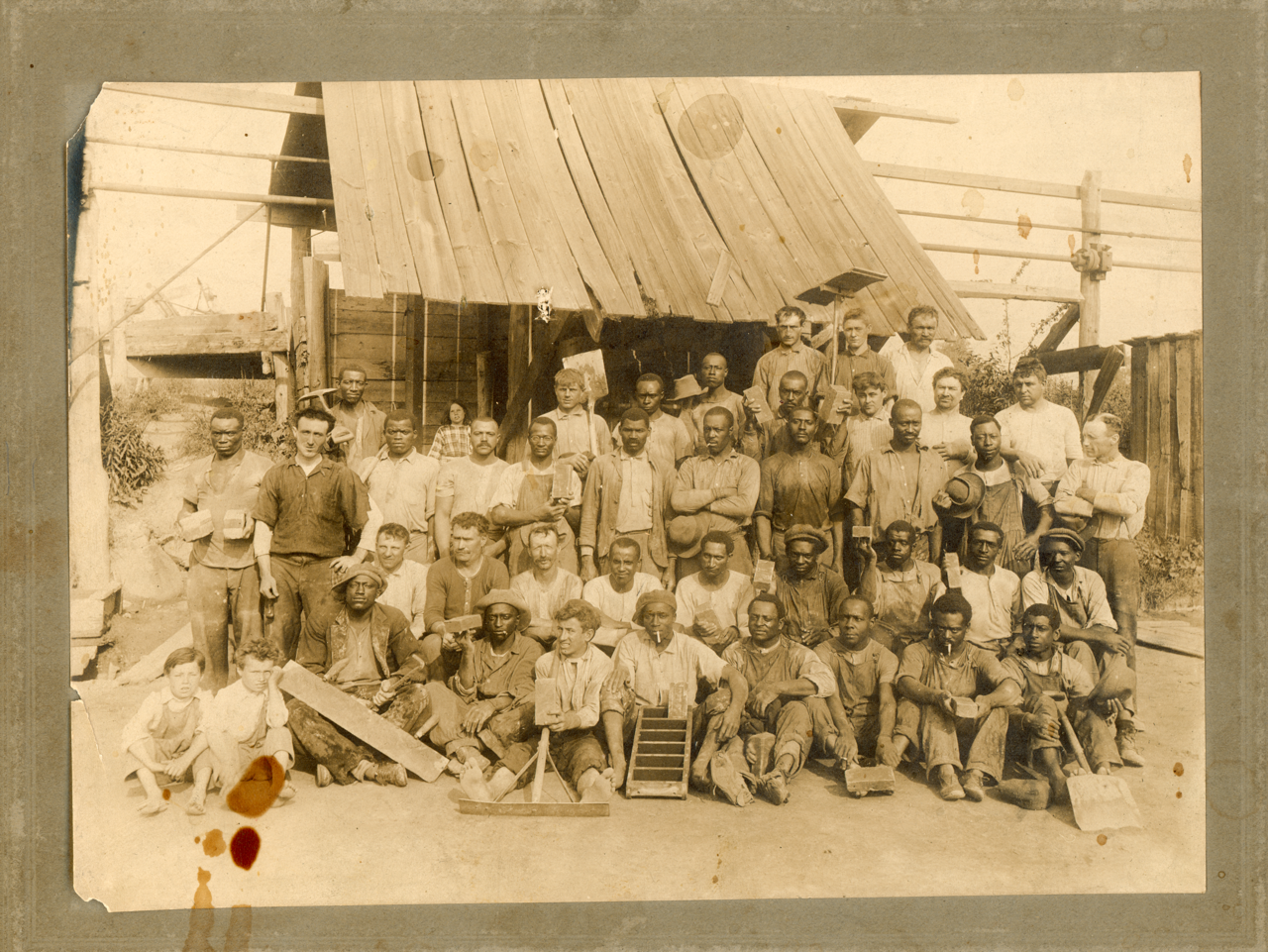
May 1st, also known as May Day, or International Workers’ Day, is used to honor laborers—past and present—as well as their struggle for recognition, dignity, and equity. [1] Haverstraw’s brickyards could not have functioned without their laborers—2,000 at the industry’s peak— let alone could the village have become the brickmaking capital of the world. [2] A photograph of Dunnigan brickyard employees, probably taken around the 1920s, encapsulates many aspects of brickyard labor. [3]
In Rockland, May 1st was often called “Settle Day,” the deadline to settle debts. Haverstraw’s economy was entirely dependent on brickmaking, a seasonal industry that — aside from occasional kiln burning — largely came to a halt in the winter months. At the same time, boat and river travel, interstate labor travel, and freight shipping also saw lulls in the winter. As a result, some stores — from blacksmith shops to grocery and butcher businesses — lent workers credit. [4]
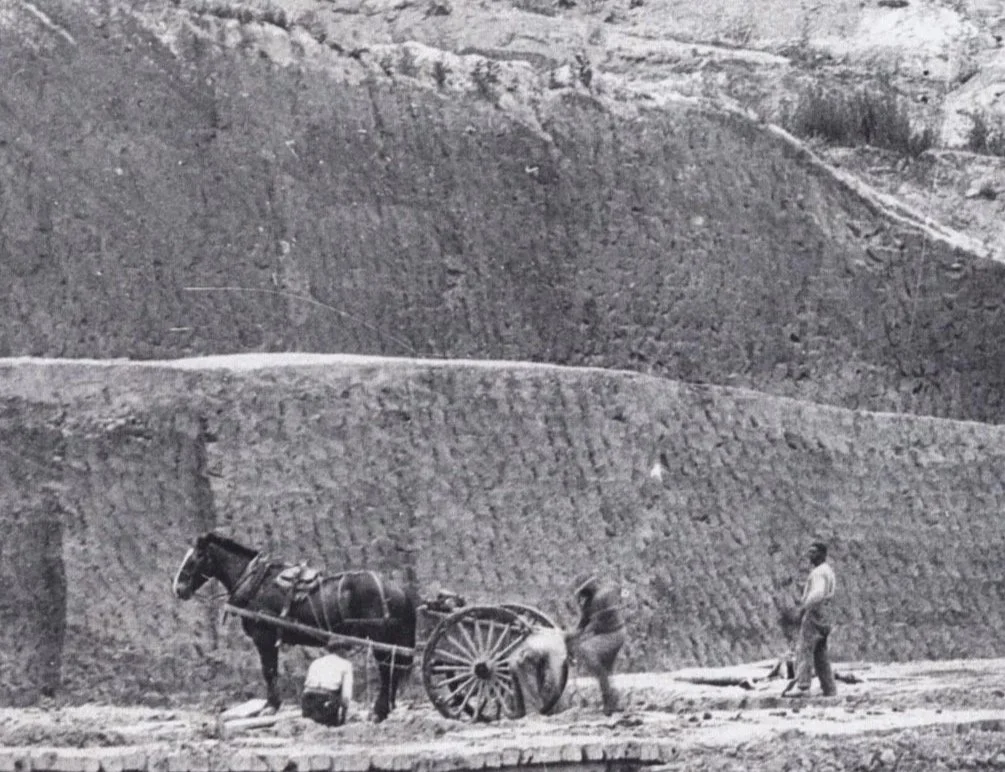
Zoomed in detail photo of the clay pit at the Excelsior Brickyard, c1900s, De Noyelles Collection, ©Haverstraw Brick Museum Archives
THE PITMeN
The shriek of whistles broke through the air around 4:30 AM at Haverstraw, signaling the beginning of the workday. The first step of brickmaking was, naturally, to excavate for clay and sand. As an unskilled position, this work was often done by recent German and Irish immigrants who had fled war and famine in the mid 1800s.”[5] Before steam shovels, clay pits were dug by hand shovel for decades, with cave-ins being frequent. On August 23, 1869, Wilhelm Rightmire, a 21-year-old German, suffocated under a sand bank collapse.[6]
Cave-ins were seemingly so common that on September 4, 1873, after a Summer without any related deaths, the Messenger wrote: “Here’s a question for the scientists to solve.”[7]Clay was sought after, regardless of human suffering, as evidenced in the Great Landslide of 1906.[8] Even in death, human remains were disregarded. On January 12, 1893, the Nyack Evening Star reported that an old burying ground on the Allison property slid into the clay pit:
“Workmen who are digging there have come across bones and skulls and shovel them up like much dirt. The workmen say they are the skulls of Indians, as some of them still show signs of warpaint.”[9]
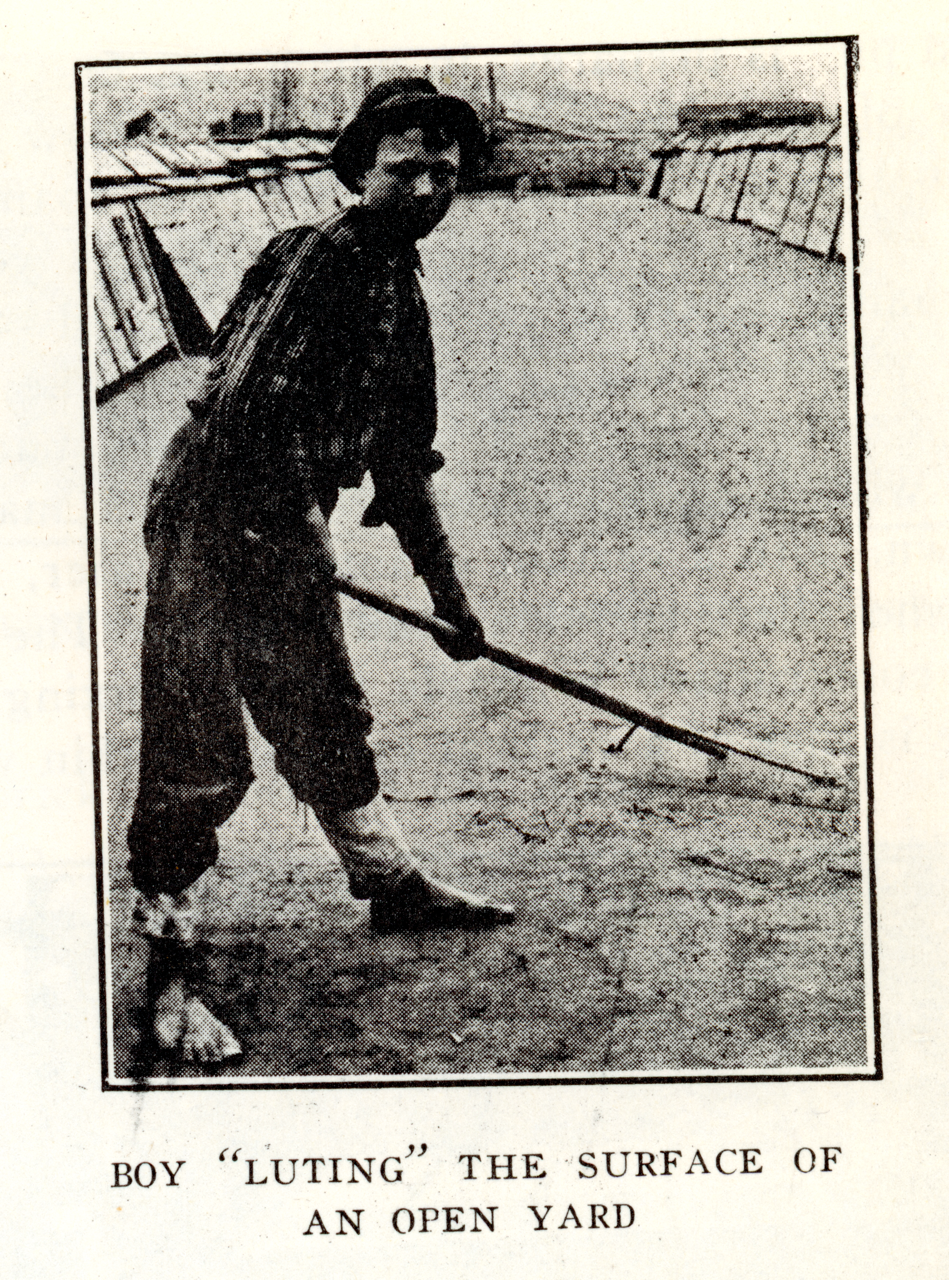
Children were also responsible for “Luting,” or flattening the drying yard before bricks were placed on them. Photo by William Thompson, The Story of Brick (New York, NYC: Building Trades Employer’s Association Bulletin, July, 1905; New York, Thiells: Daniel deNoyelles) p. 5. Citation refers to the reprint.
CHILD LABOR AND THE DRYING YARD
Some children began working in the yards as early as 5 and 8 years old. Children were highly sought for the drying yards, as their light bodies and smaller feet would not leave indentations in the purposefully flattened drying lanes (hence, they are not wearing shoes). Boys only attended school for six months, leaving in the middle of April and returning in the middle of October.[10] Children who had worked in the drying yards later moved up to the brick machines as young teenagers.
In October of 1906, the New York State Department of Labor issued a report regarding brickyard violations of state factory laws. This report found “a normal proportion of violations of the clause forbidding the employment of children under 14 years of age, and under 16 without certificates.” The issue that the inspectors emphasized was not this, but that there were numerous instances of children under 18 working before 6 AM. Even still, employers were simply “warned” of subsequent labor inspections.[11]
As recounted by Dan deNoyelles, who worked on his family’s brickyards as a teenager, children avoided “the unannounced rounds of New York State’s labor inspector” by hiding the sheds as they “did not want to be fired.”[12] Women occasionally labored on the yards in the same position, aiding “their husbands in hacking brick when he was anxious to make overtime.” [13]
BRICK PRODUCTION ON THE BRICKYARDS
Profit for brickyard owners naturally depended on how many bricks they could produce. As a rule, the more bricks they made, the more they could sell. Labor did not tend to be organized around hourly shifts;[14] instead, pay was determined upon a piece production model. In other words, pay was based upon “stints,” or roughly about ½ day’s work.[15]
The piecework system was profitable to manufacturers and discouraged slow brickmaking, helping them maximize earnings on each brick. Machinery, like Richard A. Ver Valen’s[1] 1852 automatic brickmaking machine, drastically reduced the time and labor power needed to operate the brick machines. This resulted in dramatic increases in brick quotas and subsequent cuts in wages.[16]
Speedups proved dangerous to many workers. In a brutal Summer in 1868, workers began dropping dead like flies in the heat to the point that the Rockland County Journal could not gather all of their names.[17] Picking up the pace of brickmaking also created danger for those operating brick machines too fast. On August 9, 1926, 15-year-old Vincent Labish lost two fingers to a brick machine on the De Noyelles brickyard managed by Daniel Sr., and was awarded $6,800 in damages by the state.[18]
In turn, labor battles often centered around brick quotas. As Dan De Noyelles writes, “The ‘big pit,’ 25,000 bricks, was the aim of every manufacturer and the ‘small pit,’ 22,500, the optimum goal of the workers.”[19] Foremen were tasked with enforcing these amounts.[20] Because of this, as found in the 1906 Labor Inspector’s report, laborers often worked beyond 10-hour days in order to make said quotas, sometimes beginning as early as 3:30 AM, and toiling until around 5-6 PM.[21]
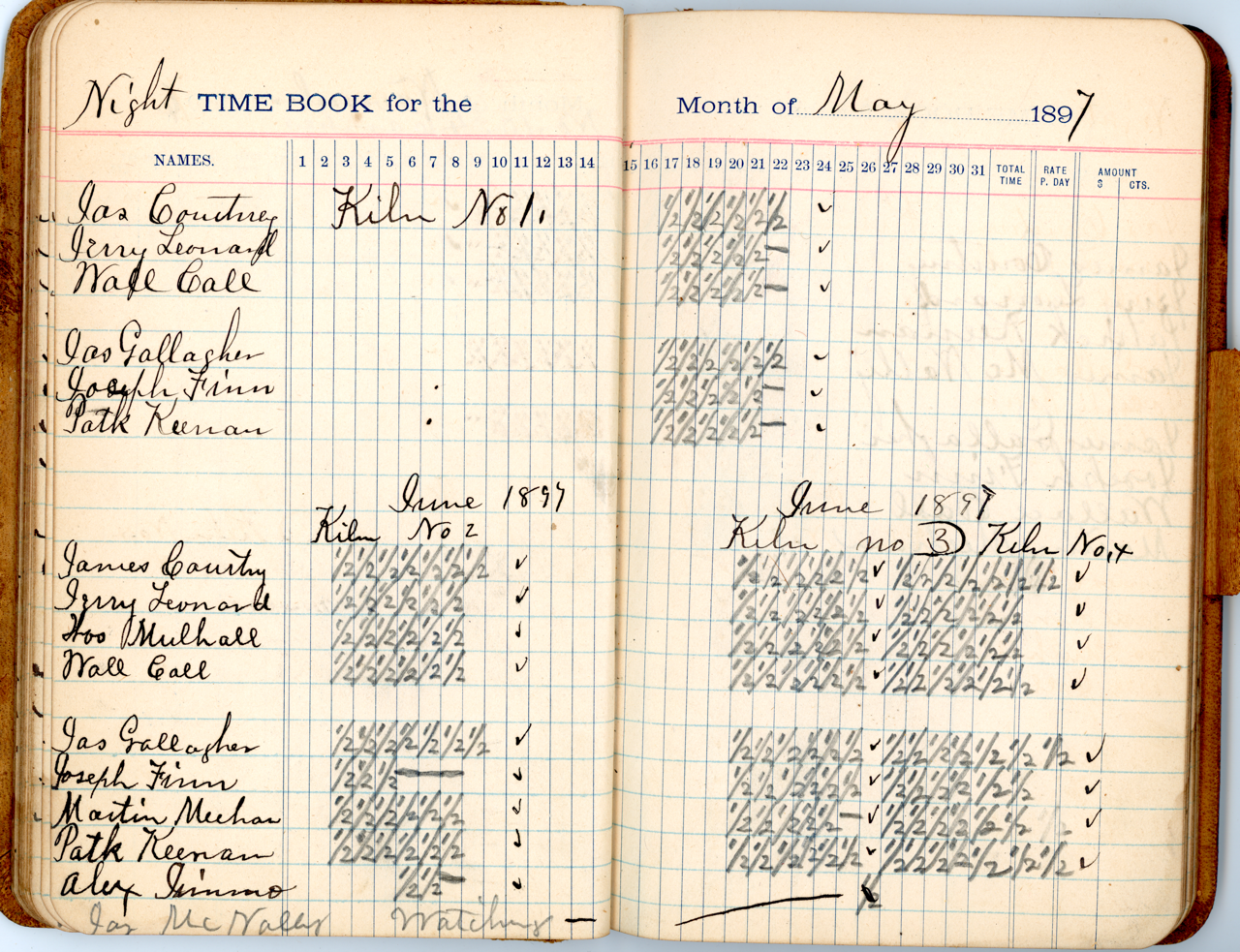
Night Time Book, 1894-1903, Reilly and Clark Collection, ©Haverstraw Brick Museum Archives. For Dan de Noyelle’s description, see Works Cited [23]
KILNMEN AND HELLFIRE
By the turn of the 20th century, the Irish had established themselves in the village and brickmaking. While James Wood’s introduction of anthracite coal was the revolutionary recipe for brickmaking, the “catalyst…would have to be the Irish foreman,” as argued by Dan deNoyelles.[22]
On May 1, 1900, a strike occurred on the Excelsior yard amongst the bricksetters. When these bricksetters — skilled workers who were responsible for building the kilns with green, sun-dried bricks — walked off the job, brickyard owners urgently needed to replace them.[24] Because of this, manufacturers sought strikebreakers.
As the Irish had become the mortar in the brickmaking industry, the Great Migration was in full swing. The recruitment of new workers became intertwined with the larger circumstances of the Great Migration, during which Black workers left the oppressive conditions of the rural south came to the North in pursuit of better economic opportunities. As a result, the brickyards workforce became roughly ⅔ or 60% African American, with the remainder composed of Italian, Hungarian, and other Eastern European immigrants.[25]
An article printed in The Rockland County Times reinforced racist assumptions of the era, reporting that “unskilled” Black workers were “plenty.” Yet, the newspaper claimed that because they were “unable to set brick, or to sand, dump or mould,” they could not supplement striking workers. While jobs such as setting did require a certain degree of practice and learned skill,
Black workers were by no means lacking resilience. Rather, racist perceptions often excluded them from skilled positions until the 1920s-30s, when some rose to the position of foreman.[26] The events at the Excelsior yard exemplified how labor unrest, economic necessity, and broader demographic shifts converged to reshape the workforce in Haverstraw.
The final step in brickmaking was firing the bricks. Brickyards could be like the surface of Venus on a hot summer day. As red and grey brick dust floated in the air from the clay pits, kilns only made the brickyards hotter as they burned at an average of 1800 degrees Fahrenheit.[27] The inhalation of fumes — which was commonly referred to as “brickyard gas” — from burning cordt wood, coal, or oil in kilns certainly taxed workers’ lungs. Local newspapers, like the Rockland County Messenger, tried to downplay this. The paper argued that if one were to “look at the physique of the very men themselves who from boyhood to old age have engaged in the manufacture of brick,” they would find that these workers were supposedly healthier than most.[28]
FAILURE OF UNIONIZATION ON THE BRICKYARDS
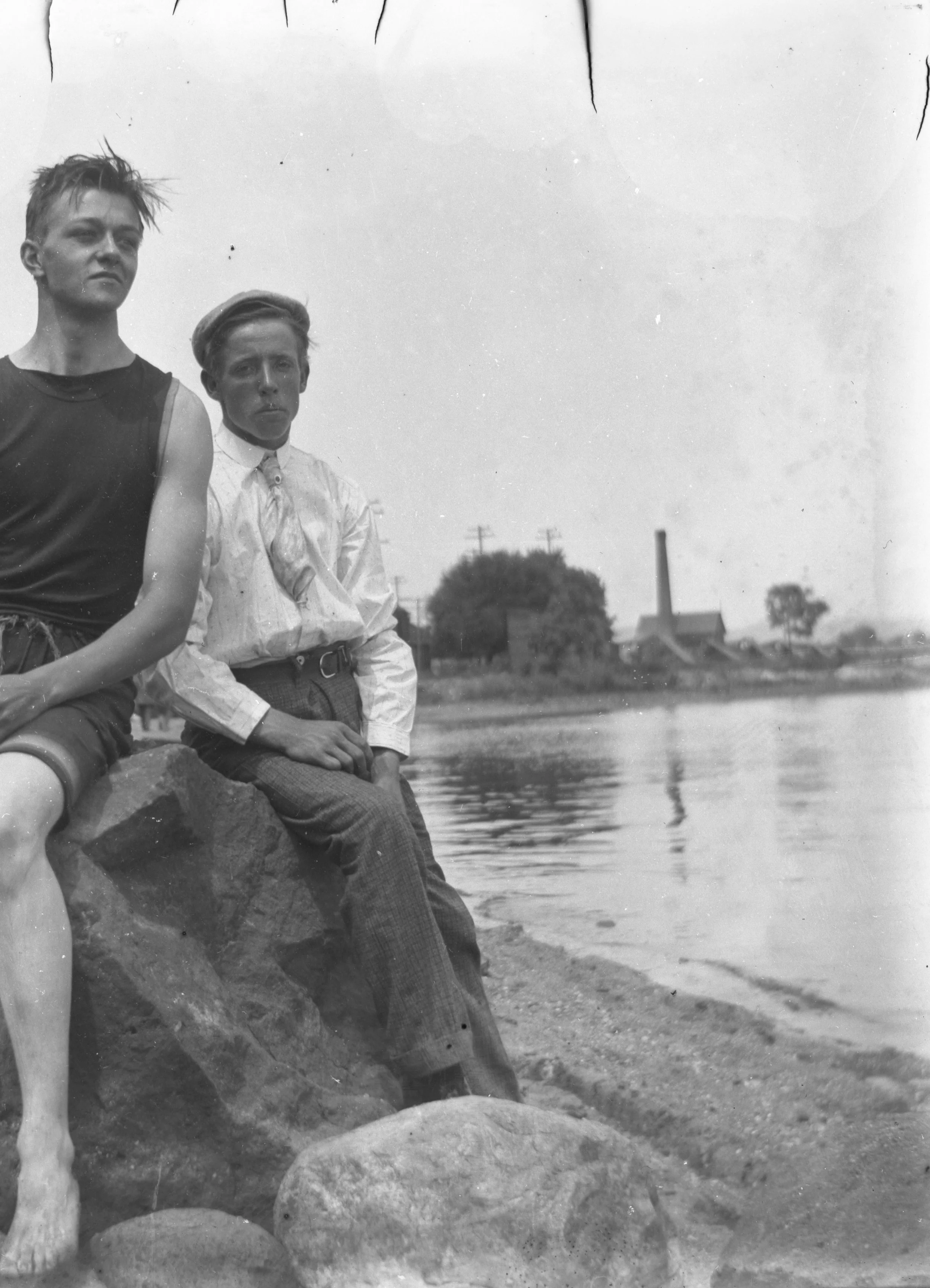
Because of the seasonal nature of brickmaking, brickyard workers often worked six days a week and had only one day for rest. Pictured are a group of boys at Redstone Beach, now Haverstraw Beach State Park. In the background is the former De Noyelles brickyard. 2009.011.142, J.W. Collection, “Groups-some at Redstone” box, Haverstraw Brick Museum Archives.
Throughout the first half of the 19th century, labor on the brickyards was largely unorganized and underrepresented. Strikes tended to erupt spontaneously, with violence being employed by both workers and brick manufacturers. While the Irish rose to become foremen and brickyard owners, the historical record suggests they took the lead in organizing. As one contemporary account noted, “Disputes in the yards often ended not with negotiation, but with fists and threats.”
Efforts to organize labor began to take shape in the late 1860’s with the foundation of the Workers’ Benevolent Society in 1868. Chaired by Bernard O’Connor, the Society demanded shorter work hours. However, they did not pursue a ‘closed-yard’ policy. In other words, they did not demand that all brickyard laborers be unionized.[29]
By 1898, a majority of yard workers were Black, and the Knights of Labor, led by Bernard J. Fox, began pushing for improved working conditions and broader labor rights. After a violent strike halted brickmaking across all Haverstraw yards, the K of L attempted to organize the workers.[30] In 1906, workers under the International Tile, Terra Cotta, and Brick Workers’ Association (ITTCBW) led a coordinated unionization and strike effort through the Hudson Valley, seeking to unify workers under a common cause. In Haverstraw, John Nolan became president of Local 197.[31]
In response to union efforts, manufacturers sometimes conceded to demands. However, they often utilized the firepower of the state, from State Troopers to the National Guard, to end strikes.[32] Moreover, they had the advantage of their “ownership,” in the words of Charles G. Burck. “From beginning to end [brickyards were] largely in the hands of local families,” while the workforce was “in a constant state of ethnic flux.”[33]
At the turn of the 20th century, brickyard owners utilized a growing transient workforce, particularly amongst the Black community, to prevent organization. When these workers organized, manufacturers refused to explicitly recognize their unions, claiming they were made up of “foreigners” who didn’t have a right to say in the manufacturers’ businesses.[34]
In a May 1922 strike, the New York Times reported around 1,200 Black workers and 600 white workers joining forces. At the negotiating table, seven Black workers and four white workers met with manufacturers. Despite the former outnumbering the latter, it seemed that manufacturers were still able to divide their workers by race, convincing most of the Black workers to accept mild wage increases when “Polish and Irish workers” refused the concession. This agreement was enforced by State Troopers “guarding” the village.[35]
In Haverstraw, historical materials show that no one union had a long enough existence. It would take until 1938 for the Brickhandlers Union of the International Longshoremen’s Association (Local 1467) to fully organize the Hudson River brick industry. However, at this time, Haverstraw brickmaking was effectively under due to the Great Depression.[36]
Written by Museum historian luke spaltro, edited by executive director rachel whitlow
FURTHER READING, CITATIONS
[1] May Day’s origins lie in the Haymarket Affair. On May 4, 1886, a demonstration for the 8-hour work day was held in Chicago. After a bomb was thrown at police, the latter fired back, killing several demonstrators. Afterwards, a number of labor organizers were given the death penalty.
[2] “Board of Trade,” Rockland County Messenger, Vol. XLVII, No. 34, Dec. 8, 1892, p. 1. https://news.hrvh.org/veridian/?a=d&d=rocklandmessenger18921208.2.2&srpos=72&e=-------en-20-rocklandmessenger-61-byDA-txt-txIN-%22brickyard%22------
[3] The Dunnigan brickyard was initially run and managed by Frank Dunnigan in Rosaville. Upon his passing, his wife, Mrs. Dunnigan (formerly a Reilly), took over the business. In 1914, it was reported that she employed 49 workers on her brickyard. “Rockland’s Industries,” Rockland County Times, Vol. XXVI, No. 13, Jan. 24, 1914, p. 1. https://news.hrvh.org/veridian/?a=d&d=rocklandctytimes19140124.1.1&srpos=16&e=-------en-20-rocklandctytimes-1-byDA-txt-txIN-%22dunnigan%22+brick------ ; “Obituary: Owen Reilly,” Rockland County Times, Dec. 30, 1916, p. 5. https://news.hrvh.org/veridian/?a=d&d=rocklandctytimes19161230.1.5&srpos=41&e=-------en-20-rocklandctytimes-41-byDA-txt-txIN-%22dunnigan%22------
[4] Daniel deNoyelles, Within These Gates (Thiells, New York: Haverstraw Brick Museum, 2002), p. 40. ; One could imagine this day’s roots came from “Moving Day,” the Dutch tradition of having leases end and begin on the same day. See Nicoline van der Sijs, Cookies, Cole Slaw, and Stoops: The Influence of Dutch on the North American Languages (Amsterdam: Amsterdam University Press, 2009), p. 187. https://www.google.com/books/edition/Cookies_Coleslaw_and_Stoops/qIsDdUSYJMIC?hl=en&gbpv=1&pg=PA187&printsec=frontcover
[5] In 1852, a contributor to the Rockland County Journal claimed that the village was overrun with foreigners — Germans, French, and Irish — looking for employment. See X, “Our Haverstraw correspondence,” Rockland County Journal, Vol. IV, No. 16, May 22, 1852, p. 2. https://news.hrvh.org/veridian/?a=d&d=rocklandctyjournal18520522.2.6&srpos=188&e=------185-en-20-rocklandctyjournal-181-byDA-txt-txIN-brick+------ ;
[6]“Coroner’s Inquests,” Rockland County Messenger, Vol. XXIV, No. 17.1, Aug. 26, 1869, p. 2. https://news.hrvh.org/veridian/?a=d&d=rocklandmessenger18690826.2.16&srpos=854&e=------186-en-20-rocklandmessenger-841-byDA-txt-txIN-brick+------
[7] “Town and County: Brief Locals,” Rockland County Messenger, Vol. XXVIII, No. 19, Sep. 4, 1873, p. 3 https://news.hrvh.org/veridian/?a=d&d=rocklandmessenger18730904.2.25&srpos=19&e=-------en-20--1-byDA-txt-txIN-%22clay+bank%22------
[8] Ezra Ratner, “Bricktown’s Rabbi and the Haverstraw Landslide of 1906, Haverstraw Brick Museum, Jan. 4, 2026, https://www.haverstrawbrickmuseum.org/from-thearchives/bricktowns-rabbi-and-the-haverstraw-landslide-of-1906
[9]“Human Bones in Brick,” Nyack Evening Star, First Year, Jan. 12, 1893, p. 1. https://news.hrvh.org/veridian/?a=d&d=jbaggcgi18930112-01.1.1&srpos=2&e=-------en-20--1-byDA-txt-txIN-%22clay+hole%22------
[10] Daniel deNoyelles, Sr., “Brickyard Memories: deNoyelles Writes of Industry,” Rockland County Times, Vol. 73, No. 12, Feb. 1, 1962, p. 2. https://news.hrvh.org/veridian/?a=d&d=rocklandctytimes19620201-01.1.2&srpos=14&e=------196-en-20-rocklandctytimes-1-byDA-txt-txIN-%22brickyard%22------
[11] Chas. Hank, “Report of the International President for the Month of October,” Brick, Tile and Terra Cotta Worker’s Journal, X, No. 4 (December, 1906): pp. 6-7 https://babel.hathitrust.org/cgi/pt?id=wu.89062230362&seq=560&q1=hudson+river ; emphasis added
[12] deNoyelles, Within These Gates, p. 150.
[13] “Woman Working,” Rockland County Times, Vol. XI, No. 33, May 5, 1900, 1. https://news.hrvh.org/veridian/?a=d&d=rocklandctytimes19000505.2.3&srpos=5&e=------190-en-20--1-byDA-txt-txIN-%22darkies%22------
[14] (other than kilnburning, which had required burning times)
[15] deNoyelles, Within These Gates, p. 47.
[16] “To All Persons Interested in Brickmaking,” Rockland County Messenger, Vol. VII, No. 6, Jun. 10, 1852, 4. https://news.hrvh.org/veridian/?a=d&d=rocklandmessenger18520610.2.27.3&srpos=1&e=------185-en-20--1--txt-txIN-%
[17] “Death From a Sandbank — Extreme Hot Weather — Men and Horses Falling Dead…” Rockland County Journal, Jul. 18, 1868, p. 2. https://news.hrvh.org/veridian/?a=d&d=rocklandctyjournal18680718.2.9&srpos=15&e=-------en-20--1-byDA-txt-txIN-%22clay+bank%22------
[18]“Labish Gets Compensation,” Rockland County Times, Vol. XXXVIII, No. 33, Oct. 13, 1928, p. 3. https://news.hrvh.org/veridian/?a=d&d=rocklandctytimes19281013.1.3&srpos=1052&e=------192-en-20-rocklandctytimes-1041-byDA-txt-txIN-brick+------
[19] deNoyelles, Within These Gates, p. 42.
[20] “The Absent-Minded Man,” Rockland County Times, Vol. XII, No. 3, Oct. 6, 1900, p. 4. https://news.hrvh.org/veridian/?a=d&d=rocklandctytimes19001006.2.21&srpos=6&e=-------en-20--1-byDA-txt-txIN-%22bernard+j+fox%22------
[21] Hank, “Report of the International President for the Month of October,” p. 8 ; “Two Thousand Brickyarders on Strike,” Nyack Evening Star, Vol. 5, No. 295, Jun. 15, 1898, p. 1. https://news.hrvh.org/veridian/?a=d&d=jbaggcgi18980615-01.1.1&srpos=20&e=------189-en-20--1-byDA-txt-txIN-brick+strike----1898%E2%80%93–
[22] deNoyelles, Within These Gates, p. 135.
[23] As noted by Dan deNoyelles, the opportunity to work extra was often taken, “the fractions scattered up and down the timekeeper’s notebook, [and] his computations looked not unlike so much hen-scratching or Egyptian hieroglyphics.” pp. 54.
[24] “Brick Setters Strike,” Nyack Evening Star, Eleventh Year, May 2, 1900, p. 1. https://news.hrvh.org/veridian/?a=d&d=jaaggbbf19000502-01.1.1&srpos=37&e=------190-en-20--21-byDA-txt-txIN-brick+strike----1900–
[25] “Old Activities Recalled,” Rockland County Times, Vol. XL, No. 45, Jan 3, 1931, p. 3. https://news.hrvh.org/veridian/?a=d&d=rocklandctytimes19310103.1.3&srpos=205&e=-------en-20-rocklandctytimes-201-byDA-txt-txIN-%22roseville%22------ . The number given in this article lines up with the picture of the Dunnigan workforce, with 26/41 laborers presumably being Black.
[26] “Men are Scarce,” Rockland County Times, Vol. XI, No. 33, May 5, 1900 p. 1. https://news.hrvh.org/veridian/?a=d&d=rocklandctytimes19000505.2.6&srpos=40&e=------190-en-20--21-byDA-txt-txIN-brick+strike----1900– ; “Many Real Estate Movements,” Rockland County Times, Vol. XXXVIII, No. 32, Oct. 6, 1928, p. 2. https://news.hrvh.org/veridian/?a=d&d=rocklandctytimes19281006.1.2&srpos=1696&e=-------en-20-rocklandctytimes-1681-byDA-txt-txIN-%22colored%22------
[27] George V. Hutton, The Great Hudson River Brick Industry: Commemorating Three and a Half Centuries of Brickmaking (Fleischmanns, New York: Purple Mountain Press, 2003) p. 54-56.
[28] “For the Rockland County Messenger: GAS! GAS!! GAS!!!,” Rockland County Messenger, Vol. XXVI, No. 35, Dec. 28, 1871, p. 2. https://news.hrvh.org/veridian/?a=d&d=rocklandmessenger18711228.2.18&srpos=77&e=------187-en-20-rocklandmessenger-61-byDA-txt-txIN-brick+------
[29] “Closed-yard” is the same as “closed-shop.” “Workingmen’s Benevolent Society,” Rockland County Messenger, Vol. XXIII, No. 22, Oct. 1, 1868, p. 2.https://news.hrvh.org/veridian/?a=d&d=rocklandmessenger18681001.2.14&srpos=748&e=------186-en-20-rocklandmessenger-741-byDA-txt-txIN-brick+------ ; James Fahey Jr., “For the Rockland County Messenger,” Rockland County Messenger, Vol. XXIII, No. 51, Apr. 22, April 1869, p. 2. https://news.hrvh.org/veridian/?a=d&d=rocklandmessenger18690422.2.19&srpos=799&e=------186-en-20-rocklandmessenger-781-byDA-txt-txIN-brick+------
[30] “Haverstraw Strike Still On,” Nyack Evening Star, Vol. 5, No. 302, Jun. 23, 1898, p. 1. https://news.hrvh.org/veridian/?a=d&d=jbaggcgi18980623-01.1.1&srpos=28&e=------189-en-20--21-byDA-txt-txIN-brick+strike----1898–
[31] The ITTCBW was an American Federation of Labor affiliate. “Local Unions,” Brick, Tile and Terra Cotta Worker’s Journal, IX, No. 7 (March, 1906) p. 19.
https://babel.hathitrust.org/cgi/pt?id=wu.89062230362&seq=237&q1=%22haverstraw%22 ;
[32] In 1877, the National Guard was called in to quell a strike as French Canadians were imported as strikebreakers. See Frank B. Green, The History of Rockland County (New York: A. S. Barnes, 1886), p. 174, https://archive.org/details/historyofrocklan00gree_0/page/174/mode/1up?q=%22haverstraw%22
[33] Charles G. Burck, “The Time’s 3-Part History of Town’s Giant Industry. Part One: Portrait of a Giant,” Rockland County Times, Vol. 15, No. 20, Apr. 2, 1964, p. 7. https://news.hrvh.org/veridian/?a=d&d=rocklandctytimes19640402-01.1.7&e=------196-en-20-rocklandctytimes-21-byDA-txt-txIN-%22brickyard%22------
[34]“Conditions Quiet Along the River,” Kingston Daily Freeman, Vol. XXXV, No. 183, May 21, 1906, p. 2. https://news.hrvh.org/veridian/?a=d&d=kingstondaily19060521.2.32&srpos=167&e=------190-en-20-kingstondaily-161-byDA-txt-txIN-brick+----1906–
[35] “Negroes Agree to End Strike on Brickyards,” The New York Times, May 17, 1922, p. 29. https://www.proquest.com/hnpnewyorktimes/docview/99545121/79449807D221433FPQ/2?accountid=13379&sourcetype=Newspapers ; “State Police Still Guarding Haverstraw,” Nyack Evening Journal, Vol. 34, No. 112, May 13, 1922, p. 1. https://news.hrvh.org/veridian/?a=d&d=jaaggbbf19220513-01.1.1&srpos=41&e=------192-en-20--41-byDA-txt-txIN-%22Haverstraw%22----1922--
[36]Hutton, The Great Hudson River Brick Industry, pp. 156-157