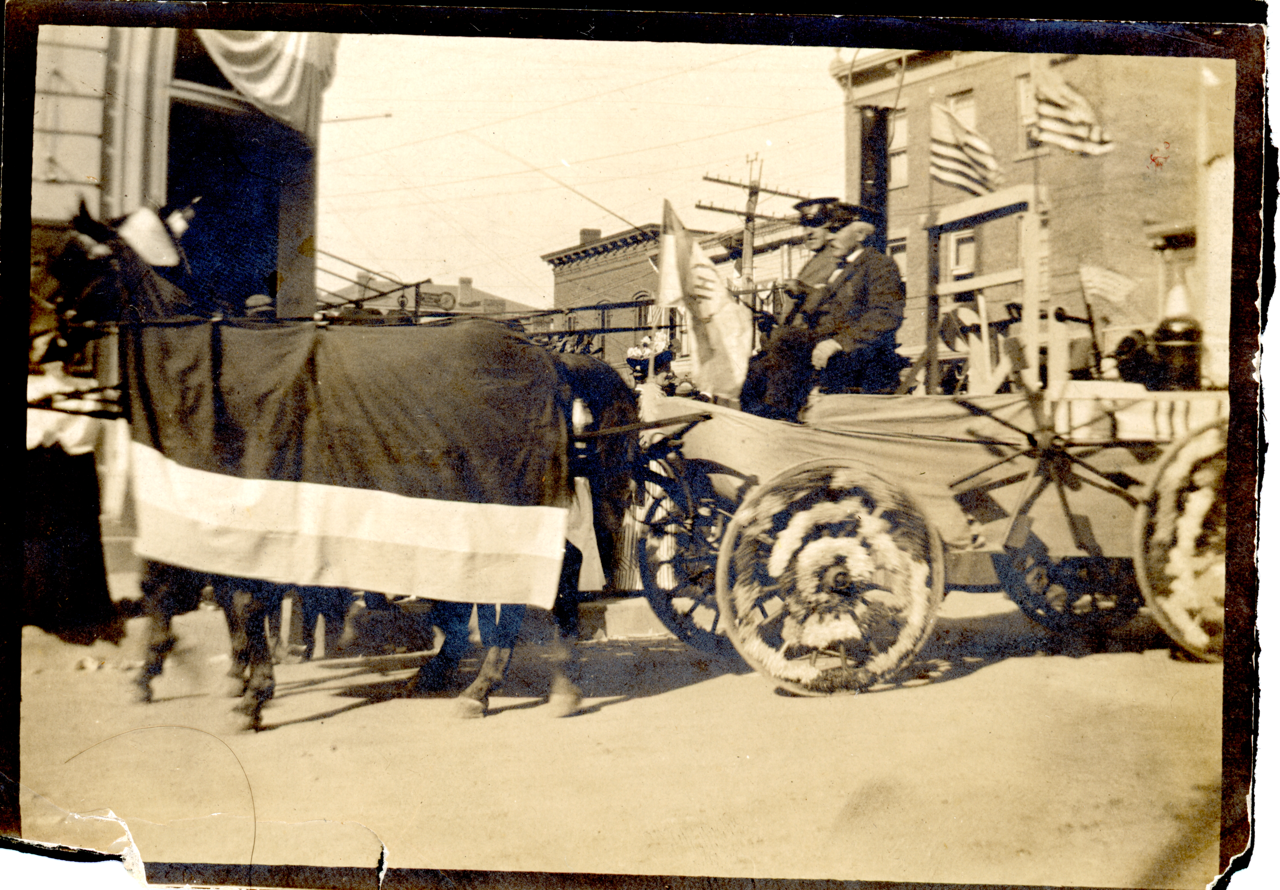
The Hudson-Fulton Celebration of 1909 changed the way we think about the River we live on.
The river valley between what is now one of the world's largest metropolises and the state capital has defined the development of a wide array of peoples, races, ethnicities, genders, etc. Place names and anniversary celebrations have memorialized the locations and historical events along its winding path. Yet it is not often recognized that these definitions of place and time are the result of struggles for power, control, and possession.
Called by some Columbus Day and by others as Indigenous Peoples Day, the struggle between narratives comes to the surface on October 12. With respect to the river valley and the former brickmaking capital of the world that sits on its shore, this struggle has played out in the ‘everyday’ vocabulary.
Throughout its recorded history, this river has been defined by those in the region as the Mahicantuck, the North River, and Hudson(‘s) River. Yet the latter name has won the power struggle and has become enshrined in the common vocabulary today. This definition cemented itself through the Hudson-Fulton anniversary celebrations of 1909, which were, at the time, the largest demonstrations held in Haverstraw.
The Dutch, and the loss of lenape language
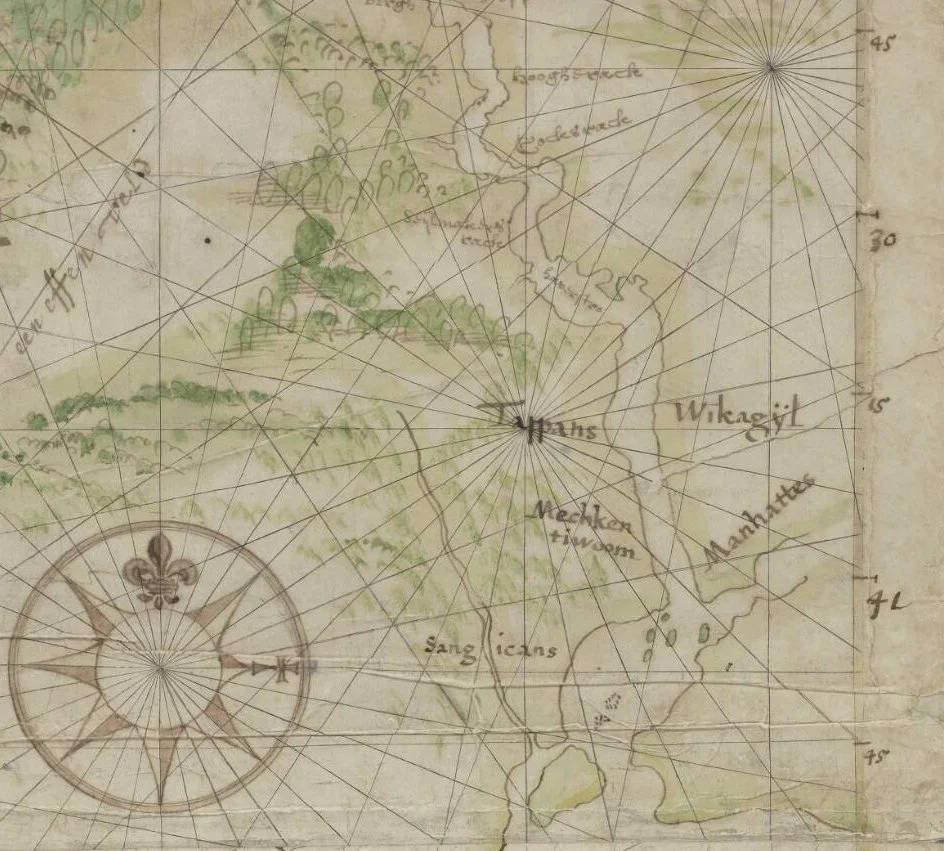
The defining inscriptions of the 1614-1616 VOC map detail identified the various Indigenous groups of the valley.[6] These descriptors of the Munsee in the region were highly corrupted by phonetic transcription between languages, as well as the Dutch imposition of Lenape groups as place names.[7] Courtesy of the Nationaal Archief.
Around September 12, 1609, the Half Moon arrived at the mouth of the river. The ship’s captain was Henry Hudson.[1] The voyage of an Englishman with a mixed English and Dutch crew was propelled by a growing mercantile capital order in Europe. The Dutch East India Company sponsored Hudson’s trip with the goal of discovering a northeastern passage to India and China.[2]
Written record of first contact comes from Robert Juet, one of Hudson’s shipmates. Places were not named, but rather described by their cardinal directions and occasionally geographic features. [3] The excursion turned violent in what would become Haverstraw. On October 1, 1609, as the Half Moon returned towards the Atlantic, violence broke out, and the crew killed several of the Munsee people. Over the coming days, the crew continued to fire upon the Lenape when they neared, until the ship sailed out of the Inlet for England.[4]
The dutch “North River” and the english “Hudson’s River”
Hudson made a second attempt to find a trade route in 1611; yet, he met his demise at the hands of a mutiny.[5] Regardless, his ‘discovery’ of the river immediately sparked interest in colonial endeavors. Between 1614 and 1616, commotion grew in the rooms of the Dutch West India Company (VOC).
A map was drafted of a region separated by three thousand miles of water in an effort to convince the Netherlands ’ States General, the nation’s parliament, to grant the company a charter. The VOC successfully convinced their government and, in 1621, was granted a charter to establish New Netherlands.[8]
As the colony expanded its boundaries, a demarcation became evident in descriptions of the river. Recorded land deeds between the Lenape and Dutch settlers were described as being along the “North River.”[9] Yet, as early as 1638, the English government of the competing Massachusetts Bay colony described the waterway as “Hudsons River.”[10] By September of 1664, the colony of New Netherlands, like Hudson, met its demise and quickly surrendered their settlements on the “North River” to the British. The colony’s new name was “New York.”[11]
Haverstroo
In the midst of Dutch Rule, the “Haverstroo” (a combination of two Dutch words) Munsee were described in 1649 as the “Remahenoncks,” and in 1654 as “Rechgawawank or Haverstroo.”[12] In 1660, they were represented by chief Rumachenanck, alias Haverstroo.”[13]
From 1664 onward, the colonists of New York quickly took advantage of the Munsee after years of Dutch wars and conquest. In 1666, Balthazar De Harte and Isaac Bedloe — “a pair of Walloon Hugenot [speculators] from the Spanish Netherlands” purchased land from the Munsee.[14]
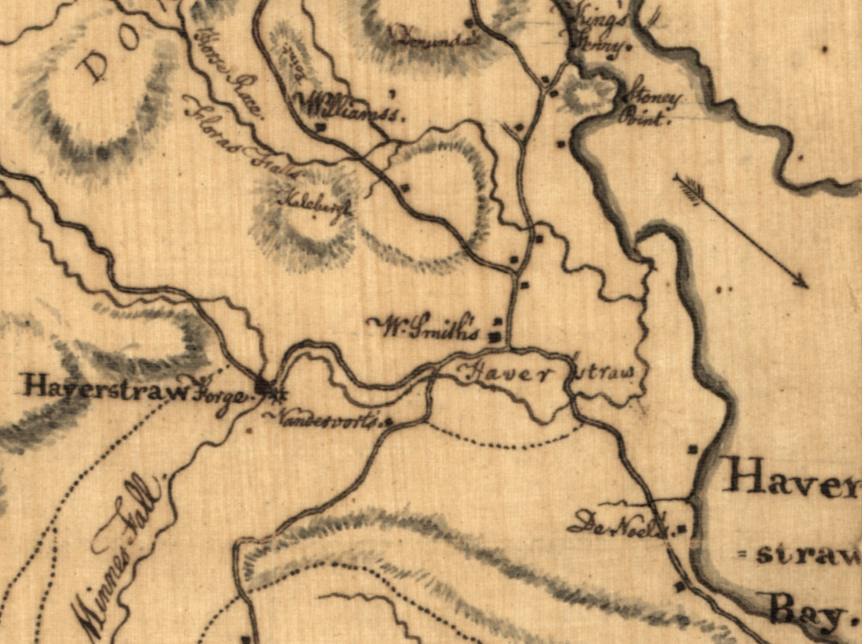
Portion of Erskine’s map detailing Haverstraw. Note “DeNoels” (De Noyelles). Courtesy of the Library of Congress.
On April 10, 1671, a patent, granted by New Jersey Governor Phillip Carteret, was certified. It included a “p’cell of Land and Meadow lying upon Hudsons River in several pieces called by the Indian names of Newa-sink, and Yandakak and Coqua-ney and Aquamek within the limits of Auverstrow [Haverstraw], bounded on the West by a Creek called Menisacongue [Minnisceongo], on the east and north by Hudsons River, on the south by the mountains.”[15]
On July 9, 1686, “upon some complaints of the Indians,” a new deed was reached for land “Being on the West side of Hudson River Called Haverstraw.”[16] These patents solidified the further displacement of the Munsee from their ancestral homelands.
Revolutionary Era
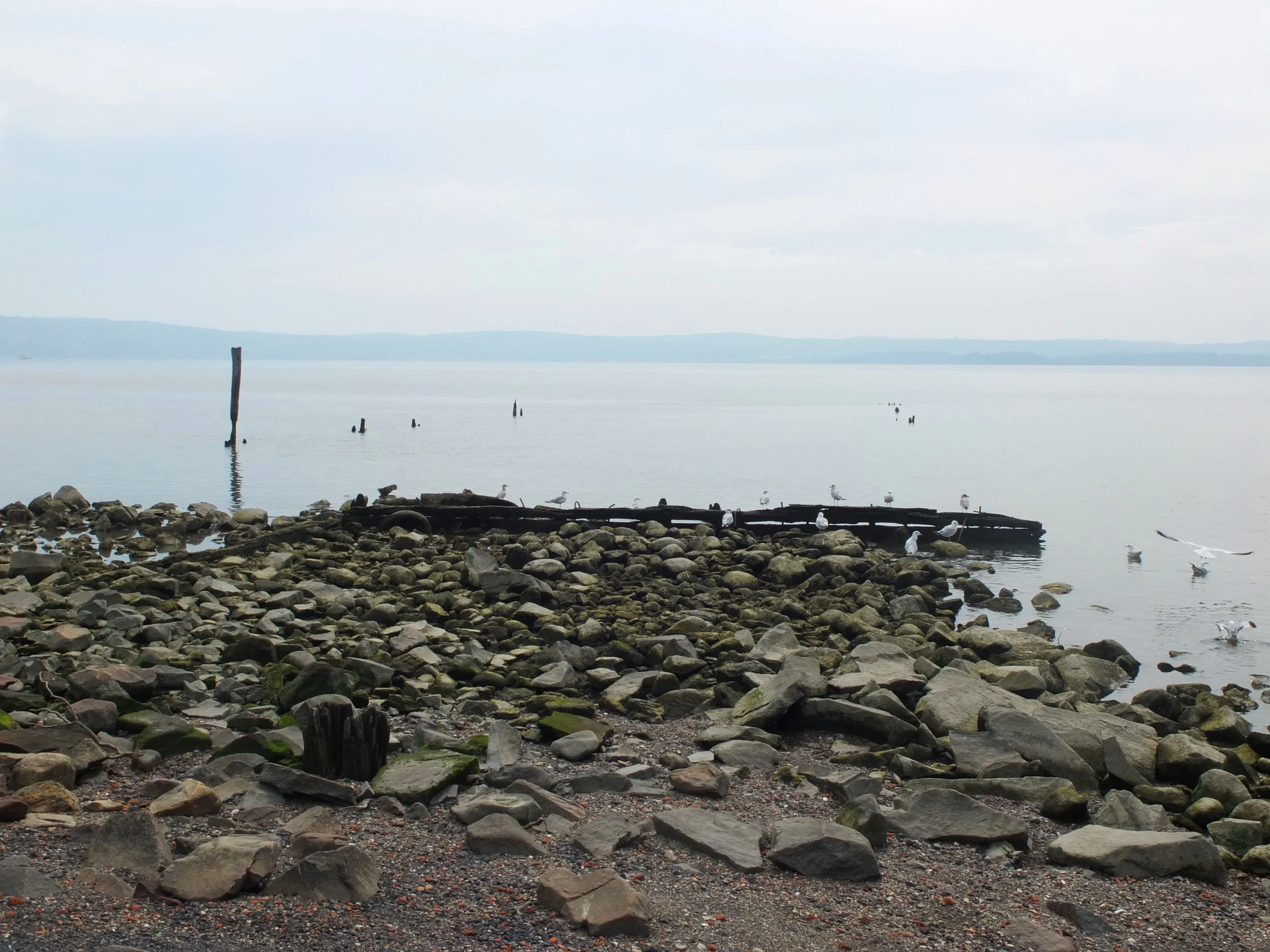
Ruins of the Excelsior Brickyard docks. Taken by the author in June 2026.
The demarcation made during the New Netherlands continued to extend into the Revolutionary era.[17] British army surveyor Claude Joseph Sauthier identified the river as the “North or Hudson.”[18] Continental Army surveyor Robert Erskine identified it as the North.[19] As the British pushed up the river in July of 1776, Munsee descriptors, such as “Tappan Bay,” were utilized by Continental Army leader George Washington. The whole river was described as the “North.”[20] The same descriptor was used during the War of 1812 against the British.[21]
Maritime usage of “North River”
In August of 1807, Robert Fulton, backed by Robert R. Livingston, began a revolution in nautical travel, successfully sailing his steamboat from the East River to the Jersey Shore.[22] In the coming years, the ship was dubbed by the New York Evening Post as the “North-River Steam Boat,” before being dubbed the “FULTON” in the midst of the 1812 war.[23] Historical accounts dubbed it the Clermont.[24]
In 1815, James Wood’s coal dust brick recipe revolutionized the Haverstraw brick industry and encouraged further investment in steam-powered nautical travel. Around 1836, the Rockland became the first steamboat to operate out of Haverstraw’s docks.[25] From 1840-1856, the Warren, the first steamboat constructed in Haverstraw, went to and from NYC.[26-27] In 1884, Haverstraw Captain David C. Woolsey purchased the legendary Emeline.[28]
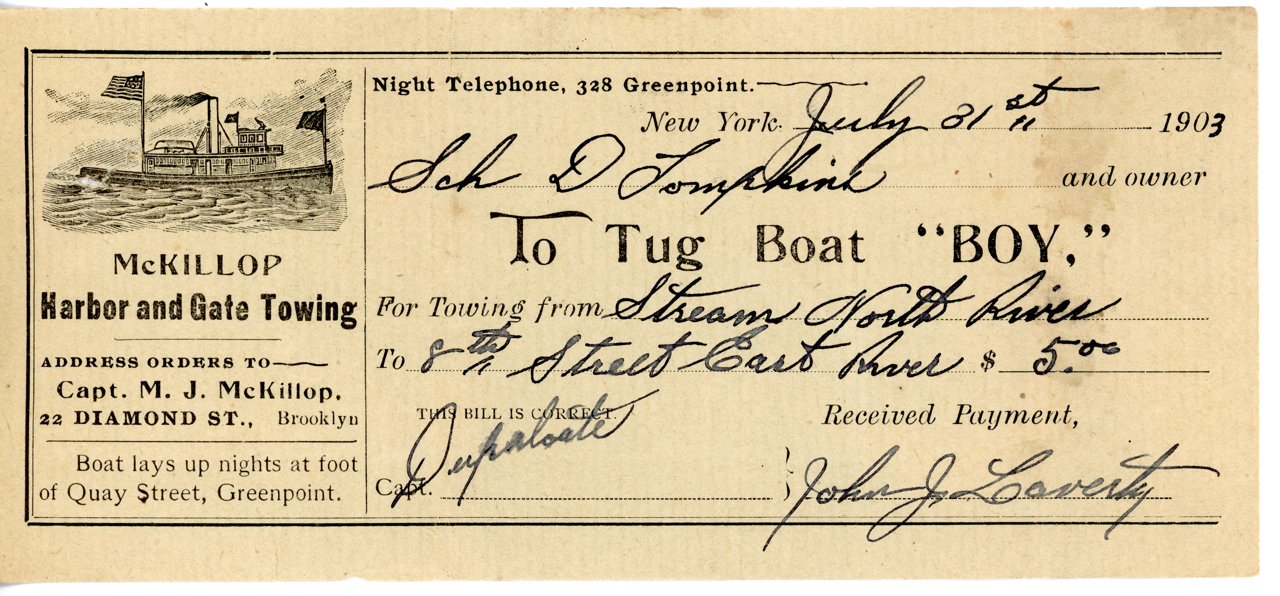
Note that the valley’s artery is described as the “North River” by the tug boat company. Schooner “Daniel Tompkins” Towing Receipts, Reilly & Clarke Papers, Haverstraw Brick Museum Archive.
Steamboats also became crucial to transporting brick. Even schooners with sails utilized steam tows when winds were slow.[29]
HOW the 1909 Hudson-Fulton Celebration CHANGED A NAME
In 1909, the Hudson-Fulton Celebration commission was formed among various prominent citizens, electoral figures, and others to "commemorate" the 300th anniversary “of the discovery of the Hudson River by Henry Hudson,” which “opened up to civilization the great river,” and the 100th anniversary “of the first successful application of steam to the navigation of the river by Robert Cleremont.”[30] The primary method to commemorate these events was in the form of a grand parade.
Haverstronians celebrated in several ways leading up to the parade. Towards the end of August, the Emeline steamer flew a tri-colored orange, white, and blue flag with a wreath in the middle encircling the initials “H.F.” for Hudson - Fulton.[31] Pins, postcards, china plates, pennants, and other souvenirs were sold at SMITH, The Stationer on Main Street.[32] Pressler’s Classy Clothes Shop and Baum Bros. made Hudson-Fulton-themed clothes advertisements and sales.[33]
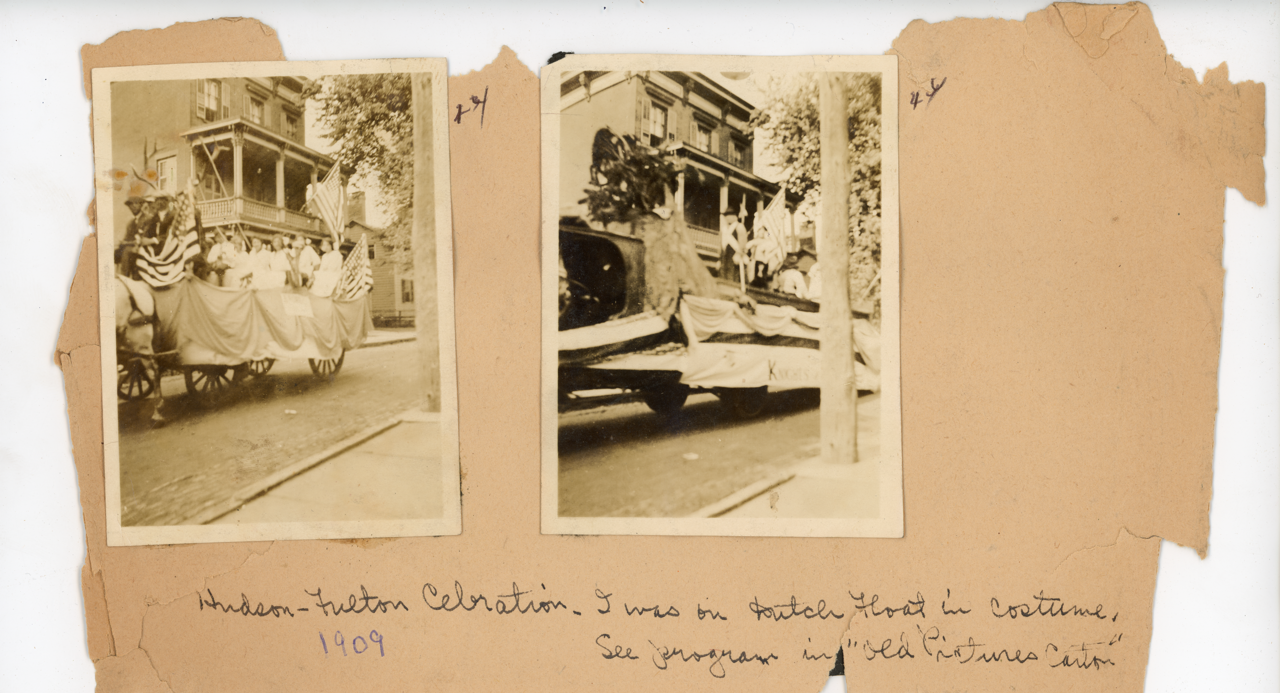
Pictures from “Mrs. Ryan’s” scrapbook. Hudson-Fulton Celebration Collection, Haverstraw Brick Museum Archive.
On September 25, New York State began its Hudson-Fulton celebration. [34] Eight hundred naval vessels, including Haverstraw’s very own Emeline, as well as “one hundred war vessels representing almost every civilized nation on the globe,” sailed into the mouth of the “Hudson” at New York City. Because these ships needed space for docking, maritime brick shipping was largely stalled.[35] Bricks that did make it to job sites were not laid either, as, according to the Rockland County Times, “contractors found it almost impossible to get men to work with so much music in the air.”[36]
Largely all business as usual in the village was stalled as well. On the day of the city’s naval parade, the “village and its vicinity was practically depopulated” as people flocked to see the ships in New York harbor. The Emeline carried a “capacity load of excursionists,” and trains on the West Shore railroad were “packed to suffocation.”[37]
In the weeks leading up to the village’s parade, decorations and “illuminations” began springing up on buildings, including the United States Hotel, People’s Bank, and National Banks. Fundraising for Haverstraw’s parade was led by George W. Morley, Head of the Finance Committee, with the aid of Alex Mendelson.[38]
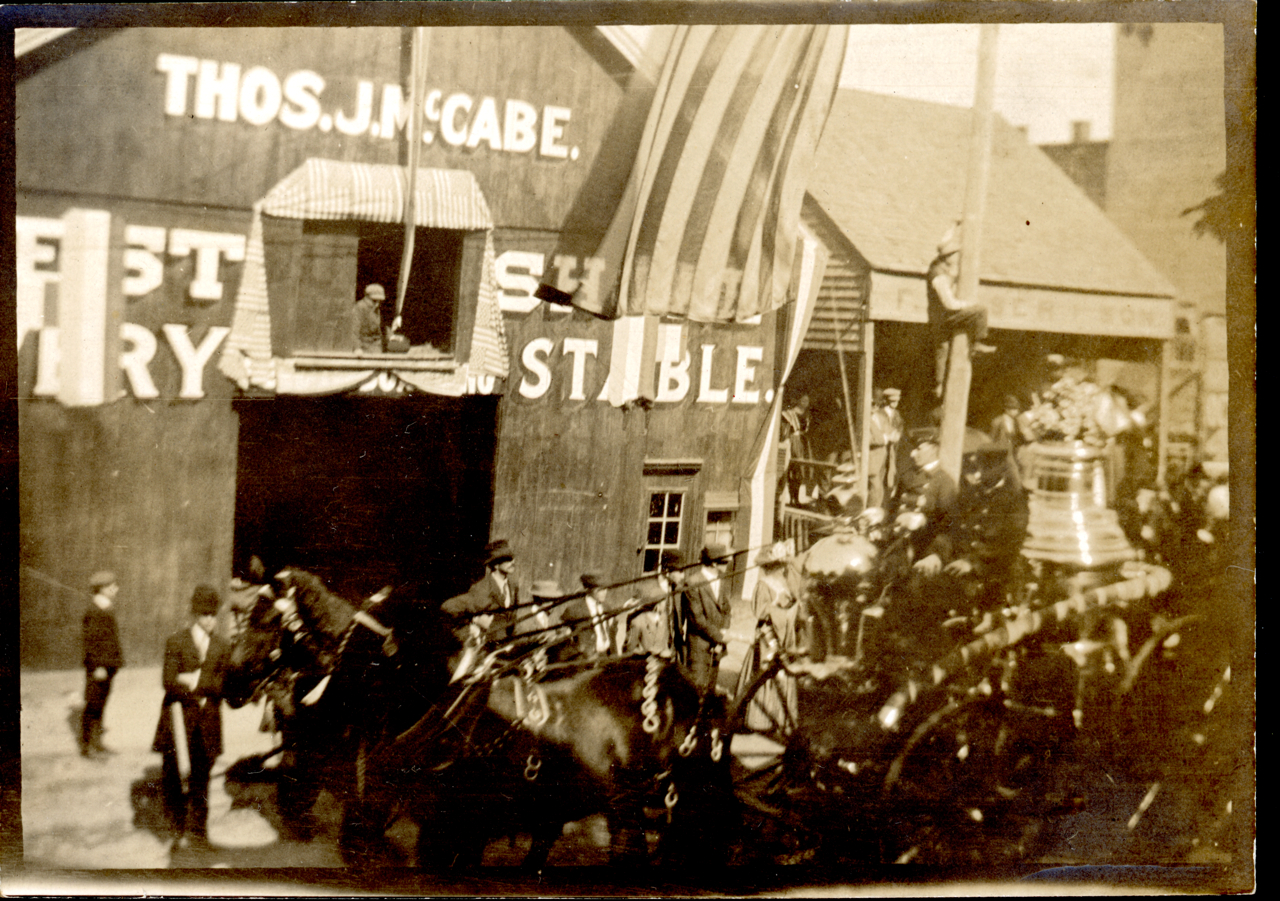
This photo was taken on New Main Street. Thomas J, McCabe’s livery . Note the man climbing the pole to get a view of the procession.
On October 7, 1909, William Benson, a member of the Civil War Grand Army of the Republic, led the parade as Grand Marshall. Beginning at the river, thousands marched, and thousands more watched a procession that stretched all the way to Hudson Avenue.
High School Classes of 1910-1913 respectively represented “the thirteen colonies driven by the Goddess of Liberty,” “Indian men and women in their camp life,” “a typical Holland scene,” and “Pilgrims in costume.” [39] The whole parade consisted of seven divisions and 63 separate groups, including the “Christopher Columbus Society [80 men].”[40] The celebration continued for the next five days, the Times reporting that “it was not an uncommon sight to see sedate, grown people going around throwing confetti on everybody they met,” and occasionally ruining “good clothes…by too generous an application of talcum powder.”[41]
On October 9, after somewhat lackluster fireworks fired below High Tor followed by “a carnival of happiness never before witnessed in this village,” the Hudson Fulton celebrations concluded. As the village’s brickyards concluded their brickmaking seasons, Haverstronians too wound down from weeks of partying.
Yet, on October 12, three days after the Hudson - Fulton celebrations concluded, new celebrations began as the first legal observance of the “Columbus Day” holiday was held in New York State. Although “[brick] manufacturing establishments in Haverstraw paid little heed” to the holiday, village banks and schools closed. The village chapter of the Knights of Columbus held a 75-member strong banquet at the United States Hotel to celebrate.[42]
The signifiCance of memorialization
In Silencing the Past, Haitian historian Michel-Rolph Trouillot argues that “Commemorations sanitize further the messy history lived by the actors.” Holidays, like Columbus Day, “void of context and marked by a fixed date,” are able to make historical events into things for “immediate consumption.” [43]
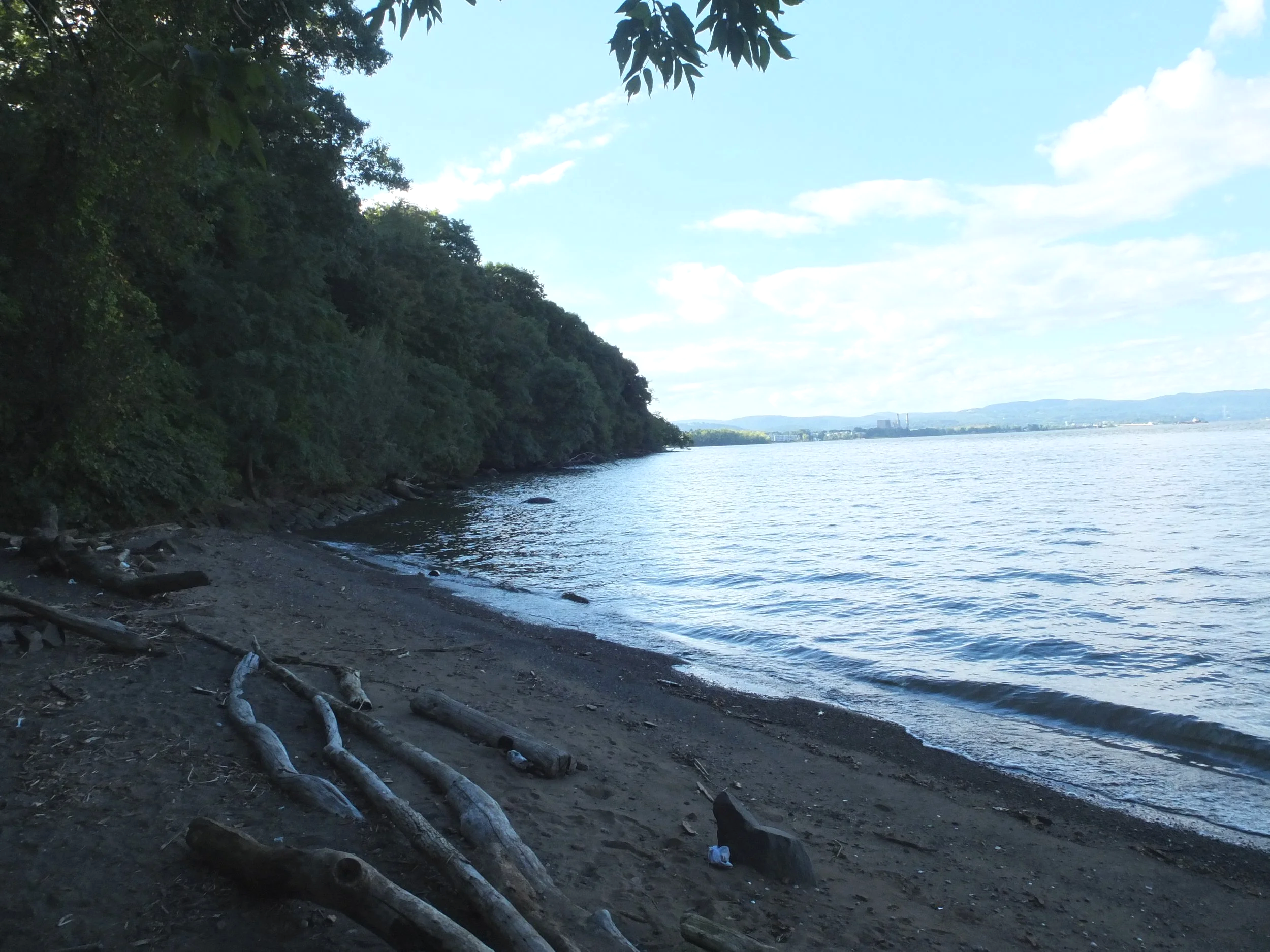
Haverstraw and Haverstraw Bay from “Redstone Beach.” Taken by author, September 2026.
Similarly to Hudson’s excursions being the result of differing European origins, the Genoese explorer’s pursuit of a middle passage was greenlit by Queen Elizabeth of Castile. Columbus’ arrival in the Americas in 1492 resulted in him becoming “a quintessential ‘Spaniard’ or a representative of ‘Italy ’-two rather vague entities during his lifetime. [44] However, in both Columbus and Hudson’s case, neither ship’s log recorded a “clear-cut milestone” of arriving at what would become San Salvador of the Bahamas or the Hudson River of New York. [45]
In the context of 1909, Haverstraw was an amalgamation of different races and ethnicities. The village and its brickyards were comprised of Irish-Americans, Italian-Americans, Jewish-Americans, and African-Americans. All had faced racism, discrimination, and violence in both Haverstraw and America. Yet, as argued by Trouillot, “All hyphens are not equal in the pot that does not melt. The second part of the compound—Irish-American, [Ashkenazi] Jewish-American, Anglo-American—always emphasizes whiteness.” The commemoration was an effective method of Americanization. [46]
Today, Haverstraw looks wholly different than it did in 1909, let alone 1609. It is home now to a large Spanish-speaking population, including Puerto Ricans, Dominicans, Mexicans, Venezuelans, etc. The context has changed. Many amongst these Central and Southern American communities have differing narratives, arriving here “by choice or by force.” In their home countries, it is often not Columbus Day, but rather a day emphasizing a “‘blending’ discourse,” such as “Discovery Day, the Day of the Americas, or simply El Día de la Raza, the Day of the Race, the day of the people.” [47]
The formation of new holidays to counteract a history of violence and erasure is most certainly a step in the right direction. On October 8, 2026, the Rockland County Legislature gave recognition to the Ramapough Munsee Lenape Nation as a part of a broader celebration of Indigenous People’s Month. [48]
With all this said, how do we reckon with the commemoration of the day-to-day language we use to describe the places we live and interact with? While language and recognition are the first step, how can we use this to forward material equity, repatriation, and reconciliation?
Written by museum historian luke spaltro. edited by executive director rachel whitlow.
______________________________________________________________________________________________________________________________________________________________________
CITATIONS AND FURTHER READING
[1] Robert Juet, Juet’s Journal: the voyage of the Half Moon from 4 April to 7 November 1609 (Newark: New Jersey Historical Society, 1959)https://archive.org/details/juetsjournalvoya0000juet/page/30/mode/1up?q=%22people%22 p. 30
[2]Kevin W. Wright, 1609: A Country That Was Never Lost -The 400th Anniversary of Henry Hudson’s Visit with North Americans of the Middle Coast (Stautan, VA: American History Press, 2009) p., 18. The Portuguese had established a stronghold on this commerce, controlling passage through the horn of Africa. In an effort to challenge this monopoly,
[3] For example, Juet writes about the points (later to become Stony and Verplanck’s) that led to the high mountain range. Juet, Juet’s Journal pp. 31-33
[4]Ibid., 35.
[5] In a longer voyage in 1611, Hudson again attempted to find a route to Asia. However, he would not see the river he once sailed take his name, after his crew mutinied and cast both him and his son adrift.
[6] The map primarily identifies a people the Dutch understood would influence the outcome of survival, let alone the settlement, of a colony. The map reads close to “Haverstroo” at the widest part of the river. Shortly under it are listed the “Tappans,” close in size to the neighboring “Manhattes.” Bea Brommer and Henk Den Heijer, Comprehensive Atlas to the Dutch West India Company: The Old WIC 1621-1674 (Voorburg: Asia Maior, 211) P. 45https://www.nationaalarchief.nl/onderzoeken/archief/2.14.97/invnr/null/file/null
[7]In this time, Munsee was not a written language. Indigenous peoples instead used petroglyphs, the Munsee often using a wolf as their motif. Munsee words were transcribed by Dutch people who spoke a foreign language. Words were further corrupted due to alphabetical differences — most notably, the Munsee did not use a phonetic “R.” Moreover, these words were not self-describing; rather, as claimed by Orange County historian Edward M. Ruttenber, they were imposed upon them by the Dutch, describing “the names of the streams on which they lived.” Arthur S. Tompkins, Historical Record to the Close of the Nineteenth Century of Rockland County, New York (Nyack: Van Deusen & Joyce) p. 46. https://archive.org/details/historicalrecord00tomp/page/n46/mode/2up?q=tappans
; “The Munsee Speaking People -River Voices from Asbury,” Musky Watershed, January 12, 2024, 0:05:00, Youtube Video, https://www.youtube.com/watch?v=bPUSg0HQjkU
https://nyheritage.org/collections/edward-m-ruttenber-collection ; Edward Manning Ruttenber, History of Orange County, New York (Philadelphia: Everts & Peck, 1881) p. 9.https://archive.org/details/cu31924028832693/page/9/mode/1up?q=haverstraw&view=theater
[8] William Dunlap, History of the New Netherlands, province of New York, and State of New York: to the adoption of the federal Constitution (New York: Carter & Thorp) p. 589 https://archive.org/details/historyofnewneth02dunl_1/page/n589/mode/2up?q=%22new+netherland%22 ;
Settlement began at “Manhattes,” or New Amsterdam for the Dutch.
[9] B. Fernow, Documents relating to the history of the early colonial settlements, principally on Long Island, edited by John Brodhead, Berhold Fernow, and Edmund O’ Callaghan (Albany, NY: Weed, Parsons and Company, 1883) p. 22. https://archive.org/details/documentsrelativ14brod/page/2/mode/2up?q=%22north+river%22
[10]Ibid., p. 446.
[11] B. Fernow, Documents relating to the history of the towns along the Hudson and Mohawk rivers, edited by John Brodhead, Berhold Fernow, and Edmund O’ Callaghan (Albany, NY: Weed, Parsons and Company, 1881) pp. 393-394. https://archive.org/details/documentsrelativ13brod/page/393/mode/1up?q=%22north+river%22 .
Granting the colony to the Duke of York, the waterway was described as “Hudsons River.” In 1683, when the County of Orange where Haverstraw sar was formed under governor Donogan, its river boundary was described as “Hudsons River.” B. Fernow, Holland Documents 1657-1678, edited by John Brodhead, Berhold Fernow, and Edmund O’ Callaghan (Albany, NY: Weed, Parsons and Company, 1858) p. 296. https://archive.org/details/documentsrelativ02brod/page/296/mode/2up?q=%22hudsons+river%22 ; B. Fernow, Documents relating to the history of the towns along the Hudson and Mohawk rivers, p. 575.
[12]Ibid., pp. 18, 25.
[13]Ibid., p. 148
[14] Robert Steven Grumet, The Munsee Indians: A History (Oklahoma: University of Oklahoma, 2009) p. 126; Edward Manning Ruttenber, History of Orange County, New York (Philadelphia: Everts & Peck, 1881) p. 21 .https://archive.org/details/cu31924028832693/page/21/mode/1up?q=haverstraw&view=theater
David Cole, History of Rockland County, New York: with Biographical Sketches of its Prominent Men (New York: J. B. Beers & Co., 1884) p. 141. https://archive.org/details/historyofrocklan00cole_0/page/141/mode/1up?q=%22steamboat%22
[15] George Henry Budke, BC-69, No. 533, Liber 1., fol. 113.
[16] The rest of the boundaries are as follows: “on the North side of the Hills called the Verdrietinge Hooke on the South Side of the High lands on the East of the Mountains soe that the same is Bounded ….with out any Reservacon of Herbage Trees or any other thing Gtowing or being thereupon.”This deed cited “ALL CHRISTIAN PEOPLE [sic] to whom this Present Writing” as Sackewaghgyn, Roansameck, Kewegham, and Seackheroes, as well as other Lenapes — most likely unchristened — including Werepekes, Krupenaemo, Apiskaemo, Rangamogh, Esquameck, Commes, Poghgnock, Mesnaghhaer, Ajanwanhanck, and Sappoetaghkammt. The Lenape that signed with marks included Sackewaghgyn, Roansameck, Kewegham, and Kackheros. George Henry Budke, BC-88, pp. 66-68.
[17] When keyword searching the National Historical Publications & Record Commission's “Founders Online” papers, “Hudson River” returns 819 hits, while “North River” returns 1,348. Founders online: Home. Accessed October 11, 2026. https://founders.archives.gov/.
[18]Sauthier, Claude Joseph, and William Faden. A topographical map of Hudsons River, with the channels depth of water, rocks, shoals &c. and the country adjacent, from Sandy-Hook, New York and bay to Fort Edward, also the communication with Canada by Lake George and Lake Champlain, as high as Fort Chambly on Sorel River. [London, Wm. Faden, 1777] Map. https://www.loc.gov/item/74693013/.
[19] Erskine, Robert, and Nathanael Greene. Map of Orange and Rockland counties area of New York. [1779] Map. https://www.loc.gov/item/gm71002215/.
[20]“Council of War, 8 July 1776,” Founders Online, National Archives, https://founders.archives.gov/documents/Washington/03-05-02-0169. [Original source: The Papers of George Washington, Revolutionary War Series, vol. 5, 16 June 1776 – 12 August 1776, ed. Philander D. Chase. Charlottesville: University Press of Virginia, 1993, pp. 238–239.]
[21] https://founders.archives.gov/?q=%22north%20river%22&s=1111311113&sa=&r=1326&sr=
[22] Thomas Wallace Knox, The life of Robery Fulton and a history of steam navigation (New York: G,P Putnam, 1900) p. 104 https://archive.org/details/lifeofrobertfult00knox/page/104/mode/2up?q=%22hudson+river%22
[23]Cadwallader David Colden, The Life of Robert Fulton (Wall Street, New York: Kirk & Mercein, 1817) p. 169. https://archive.org/details/liferobertfulto00coldgoog/page/n169/mode/1up?q=%22hudson+river%22 ; “Steamboat Notice,” New-York Evening Post, No. 2748, March 18, 1811, p. 3. https://www.nyshistoricnewspapers.org/?a=d&d=nep18110318-01.1.3&srpos=2&e=-------en-20--1-byDA-txt-txIN-%22steamboat%22--------- ; “Steamboat Notice,” New-York Evening Post, No. 3674, May 16, 1814, https://www.nyshistoricnewspapers.org/?a=d&d=nep18140516-01.1.1&srpos=129&e=-------en-20--121-byDA-txt-txIN-%22fulton%22---------
[24] Knox, The life of Robery Fulton and a history of steam navigation, p. 116.
[25] In the same time, newspaper editors, who were responsible for creating the historical record, strayed away from Hudson. The village’s first paper in 1829 was dubbed The North River Palladium. 1834 saw the North River Times. Both papers were fairly short lived. Arthur S. Tompkins, Historical record to the close of the nineteenth century of Rockland County, New York (Nyack, N.Y.: Van Deusen & Joyce) p. 258. https://archive.org/details/historicalrecord00tomp/page/258/mode/1up?q=%22mccabe%22 ; Cole, History of Rockland County, New York, p. 175.
[26] Ibid., p. 181.
[27] Both were piloted by Samuel A. Ver Valen, brother of Richard A. Ver Valen, inventor of the 1852 automatic brickmaking machine.“Obituary: Samuela. Vervalen,” Independent Advisor, Vol. 6, No. 16, June 10, 1887, p. 1. https://news.hrvh.org/veridian/?a=d&d=indadv18870610.1.1&srpos=45&e=-------en-20--41-byDA-txt-txIN-%22steamboat+rockland%22------
[28] Luke Spaltro, “Travel on the Hudson, and Haverstraw’s Queen of the River: The Emeline,” Haverstraw Brick Museum, November 20, 2025, https://www.haverstrawbrickmuseum.org/bricktalks/travel-on-the-hudson-and-haverstraws-queen-of-the-river-the-emeline
[29]William duBarry Thomas, “The Evolution of the Hudson River Towing Industry,” Hudson River Maritime Museum, March 3, 2022. “https://www.hrmm.org/history-blog/the-evolution-of-the-hudson-river-towing-industry?srsltid=AU7gw4Vj1irPHoxY48mO5DJtkdfWRNLghOoI0zmhAK6VN_tKf29Uycom
[30]The latter was pushed back two years to line up the naval parade. Hudson-Fulton Celebration Commission, “Official Program: Hudson Fulton Celebration” (New York: Redfield Bros, 1909) p. 3. https://archive.org/details/officialprogram00huds/page/3/mode/1up
[31]“Starting in Late,” Rockland County Times, Vol. XX, No. 44, August 21, 1909, p. 1. https://news.hrvh.org/veridian/?a=d&d=rocklandctytimes19090821&e=------190-en-20-rocklandctytimes-121-byDA-txt-txIN-%22hudson%22----1909– ; https://www.crwflags.com/fotw/flags/us-ny_hf.html
[32]Smith, The Stationer, “Hudson Fulton Decorations Are Now Selling Rapidly,” Rockland County Times, Vol. XX, No. 44, August 21, 1909, p. 2. https://news.hrvh.org/veridian/?a=d&d=rocklandctytimes19090918.1.2&srpos=156&e=------190-en-20-rocklandctytimes-141-byDA-txt-txIN-------
[33]Baum Bros, “Hudson-Fulton Celebration Apparel for Men and Boys,” Rockland County Times, Vol. XX, No. 49, October 2, 1909, p. 8.https://news.hrvh.org/veridian/?a=d&d=rocklandctytimes19091002.1.8&srpos=174&e=------190-en-20-rocklandctytimes-161-byDA-txt-txIN-%22hudson%22----1909– ;Pressler’s Classy Clothes Shop, “View The Great Navel Pageant In Pressler’s Classy Clothes,” Rockland County Times, Vol. XX, No. 49, October 2, 1909,p. 9. https://news.hrvh.org/veridian/?a=d&d=rocklandctytimes19091002.1.9&srpos=175&e=------190-en-20-rocklandctytimes-161-byDA-txt-txIN-%22hudson%22----1909%E2%80%93–
[34]“Hudson and Fulton,” Rockland County Times, Vol. XX, No. 44, August 28, 1909, p. 4. https://news.hrvh.org/veridian/?a=d&d=rocklandctytimes19090828.1.4&srpos=144&e=------190-en-20-rocklandctytimes-141-byDA-txt-txIN-%22hudson%22----1909–
[35]“Committee at Odds,” Rockland County Times, Vol. XX, No. 48, September 25, 1909, p. 1. https://news.hrvh.org/veridian/?a=d&d=rocklandctytimes19090925.1.1&srpos=161&e=------190-en-20-rocklandctytimes-161-byDA-txt-txIN-%22hudson%22----1909–
[36]“Haverstraw,” Rockland County Times, Vol. XX, No. 50, October 9, 1909, p. 8. https://news.hrvh.org/veridian/?a=d&d=rocklandctytimes19091009.1.8&e=------190-en-20-rocklandctytimes-141-byDA-txt-txIN-%22brick%22----1909–
[37]“The Town Ablaze,” Rockland County Times,Vol. XX, No. 49, October 2, 1909, p. 1. https://news.hrvh.org/veridian/?a=d&d=rocklandctytimes19091002.1.1&e=------190-en-20-rocklandctytimes-161-byDA-txt-txIN-%22hudson%22----1909–
[38]Ibid.
[39]“Celebration Big Success,” Rockland County Times, Vol. XX, No. 50, October 9, 1909, p. 1. https://news.hrvh.org/veridian/?a=d&d=rocklandctytimes19091009.1.1&e=------190-en-20-rocklandctytimes-181-byDA-txt-txIN-%22hudson%22----1909–
[40]Ibid., p. 5.
[41]“The Lights Go Out,” Rockland County Times, Vol. XX, No. 51, October 16, 1909, p. 1. https://news.hrvh.org/veridian/?a=d&d=rocklandctytimes19091016.1.1&e=------190-en-20-rocklandctytimes-181-byDA-txt-txIN-%22hudson%22----1909%E2%80%93–
[42]“Columbus Day Observed,” Rockland County Times, Vol. XX, No. 51, October 16, 1909, p. 1. https://news.hrvh.org/veridian/?a=d&d=rocklandctytimes19091016&e=------190-en-20-rocklandctytimes-181-byDA-txt-txIN-%22hudson%22----1909–
[43] Michel-Ralph Trouillot, Silencing the Past: Power and the Production of History (Boston, MA: Beacon Press, 1995) pp. 116, 114.
[44] Ibid., p.114.
[45] Ibid., p. 140 Juet, Juet’s Journal, pp. 30-31.
[46] Trouillot, Silencing the Past, p. 133
[47] Ibid., pp. 136, 139.
[48] Rockland County Legislature, “The Rockland County Legislature proudly recognized the Ramapough Munsee Lenape Nation in celebration of Indigenous Peoples’ Month…,” Facebook, October 8, 2026. https://www.facebook.com/rockleg/posts/the-rockland-county-legislature-proudly-recognized-the-ramapough-munsee-lenape-n/1541106628047599/